Why does looking far into space mean looking back in time?
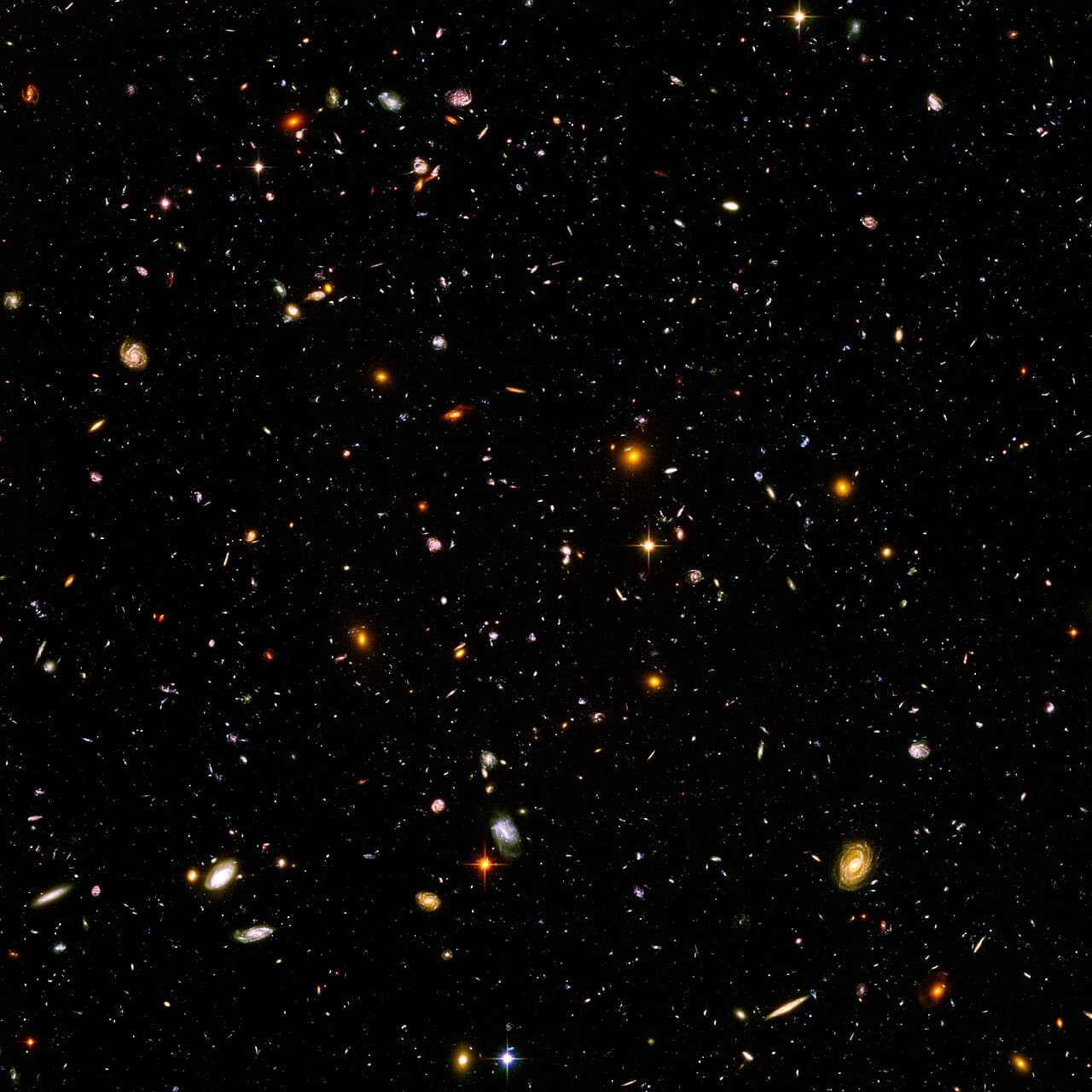
The deepest photo Hubble ever took shows galaxies as they looked 13 billion years ago, not as they look now.
▶ Start the storyLight doesn't arrive instantly. It travels at a fixed speed, and crossing the huge distances of space takes time. So when you look at something far away, you aren't seeing it as it is now: you're seeing the light it sent out long ago, when it left. The farther away something is, the older the picture.
Astronomers measure these distances in light-years, the distance light travels in one year, about 9.46 trillion kilometres. It's a unit of distance, not time, even though it has 'year' in the name. The unit appeared soon after 1838, when Friedrich Bessel first measured the distance to a star. He found that its light takes 10.3 years to reach us. He knew readers would enjoy picturing that trip, but he avoided using 'light-year' himself.
This delay means a telescope pointed far enough away is also a kind of time machine. Over 2003 and 2004, Hubble stared for a total of about eleven days at one small, carefully chosen patch of sky. It had few bright nearby stars in the way, so fainter, far more distant galaxies could show through. The resulting image, the Hubble Ultra-Deep Field, captured about 10,000 galaxies, some as they looked roughly 13 billion years ago, within the first billion years after the Big Bang. A follow-up pushed even further, to light from just 450 million years after it.
There's a limit to how far back this can go. Nothing can travel faster than light, and the universe has existed for only about 14 billion years, so there's a boundary, the particle horizon, beyond which no light has had time to reach us yet. Everything we can possibly see lies inside that boundary, called the observable universe.
Quiz me
0/3
Recap
The farther away you look in space, the farther back in time you are seeing, because light needs time to cross the distance.
Surprising fact · About eleven days of total Hubble exposure on one tiny patch of sky, released in 2004, revealed galaxies seen as they were about 13 billion years ago, less than a billion years after the Big Bang.
Sources (4)
No source, no claim. Every fact in this lesson (16 claims) cites at least one of these.