How do we know the universe is expanding?
A Belgian priest worked it out two years before the American astronomer it was named after, and later cut the key equation from his own English translation.
▶ Start the storyBecause almost every distant galaxy is moving away from us, and the farther away it is, the faster it goes. That pattern, now called Hubble's law, or officially the Hubble–Lemaître law, says galaxies recede from Earth at speeds proportional to their distance, and it was the first observational basis for the expansion of the universe. Astronomers get a galaxy's speed by measuring its redshift, a shift in the frequency of the light it emits.
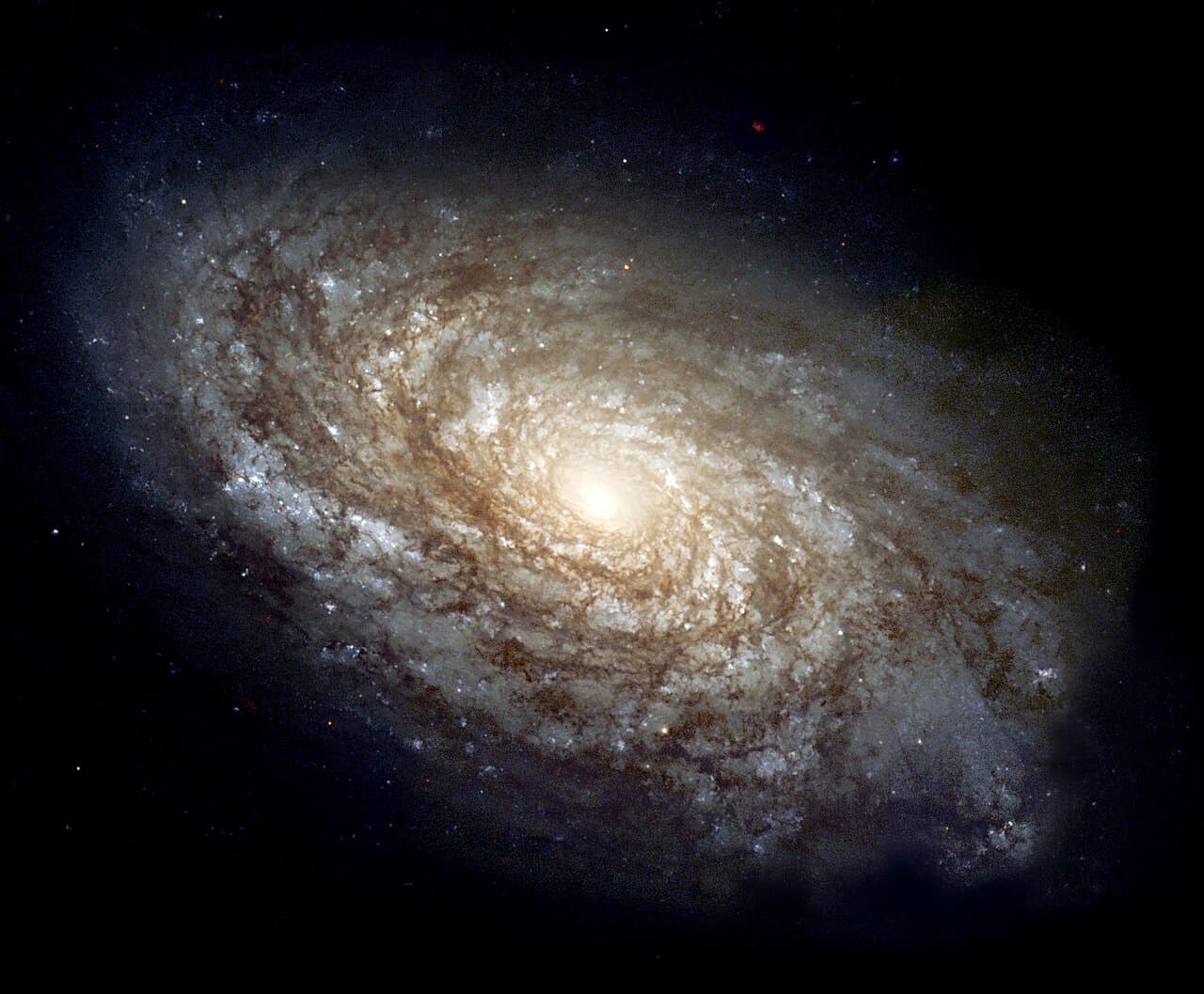
Edwin Hubble gets the credit, for work published in 1929. Using Cepheid variable stars in "spiral nebulae," he calculated their distances and found, surprisingly, that they lay well outside the Milky Way. But he built on others: Vesto Slipher had measured the first redshift of a spiral nebula back in 1912 without grasping what it meant, and combining Slipher's velocities with Henrietta Swan Leavitt's method for distances let Hubble calculate an expansion rate.
The twist belongs to a Belgian priest and astronomer, Georges Lemaître, who derived the same relationship two years earlier, in 1927, and even estimated the ratio that later became known as the Hubble constant. His paper was written in French and published in a low-impact journal. In the high-impact English translation of 1931, a critical equation was changed, dropping what is now called the Hubble constant, and it is now known that Lemaître made the change himself.
Today the law is one of the pieces of evidence most often cited for the Big Bang. It is written v = H₀D, where the Hubble constant H₀ is about 70 km/s for every megaparsec of distance: a galaxy twice as far away recedes about twice as fast.
Quiz me
0/3
Recap
The farther away a galaxy is, the faster it is moving away from us.
Surprising fact · Georges Lemaître derived the law in 1927, two years before Hubble, in a French paper in a low-impact journal, and later removed the key equation from the English translation himself.
Sources (1)
No source, no claim. Every fact in this lesson (12 claims) cites at least one of these.