Why do free markets make too much pollution, and can a price fix it?
When a factory's smoke costs its neighbours but not the factory, the market's price is wrong, and the market dutifully makes too much of it.
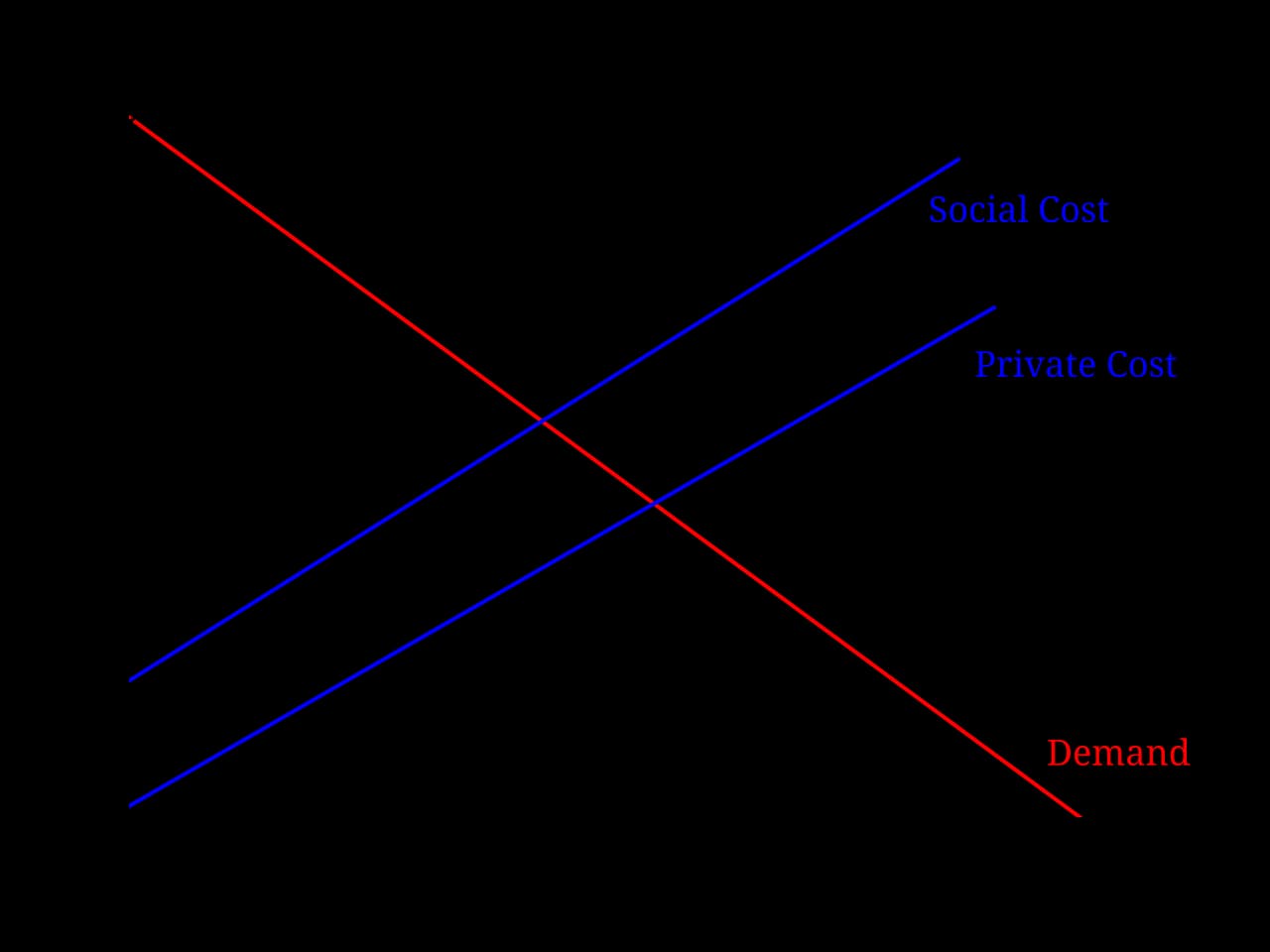
▶ Start the storyBecause the price of the product leaves out part of its cost. Economists call that missing part an externality: a cost, or a benefit, that lands on someone who had no say in the deal. When you drive, the cost of the air pollution is paid neither by the car maker nor by you, but by everyone breathing nearby. A negative externality is exactly the gap between what something costs the person deciding and what it costs society.
Markets respond to prices, so a price that is too low leads to too much. The efficient amount of any activity is where the extra benefit to society equals the extra cost to society. If part of the cost is invisible to the buyer and seller, they keep going past that point. Economists call this a market failure: resources could be allocated better.
In 1920 the British economist Arthur Pigou proposed a fix: tax the activity by an amount equal to the extra damage it causes. Then the price tells the truth again, and buyers and sellers cut back to the efficient level on their own. The catch is that regulators rarely know the true damage precisely.
It works in reverse too. A farmer's bees pollinate the neighbour's crops for free, so the neighbour has no reason to buy bees himself, and too few bees get kept. That is why governments subsidise things like flu vaccines and research. And in 1960 Ronald Coase added a twist: if people can bargain cheaply, they can sometimes sort it out without any tax at all.
Step 1: A hidden cost
Part of the cost of producing falls on neighbours, not on buyers or sellers.
Step 2: Too much gets made
The market overshoots the level where social benefit equals social cost.
Step 3: Tax the damage
Set a tax equal to the marginal harm done to others.
Step 4: Prices tell the truth
Buyers and sellers cut back to the efficient level on their own.
Quiz me
0/3
Recap
Make the price tell the truth: tax the harm (Pigou) or let people bargain over clear rights (Coase).
Surprising fact · Coase's rancher-and-farmer example showed that the harm runs both ways: stopping the cattle hurts the rancher as much as free cattle hurt the farmer.
Sources (4)
No source, no claim. Every fact in this lesson (26 claims) cites at least one of these.