Why did ordinary people keep pressing the shock button?
In Stanley Milgram's 1961 experiment, every volunteer went up to 300 volts on a fake shock machine, and 65% went all the way to 450. Why they did is still argued over.
▶ Start the storyMilgram's answer was authority. In his experiments at Yale, which began in August 1961, an experimenter in a lab coat told each volunteer "teacher" to keep shocking a "learner" for every wrong answer, and used a fixed script of prods when anyone hesitated, ending with "You have no other choice; you must go on." Milgram argued that people come to see themselves as the instrument of someone else's wishes, and so stop feeling responsible for what they do. Later researchers who examined his archive offer another reading, "engaged followership": people obeyed less when a prod sounded like an order and more when it stressed that the experiment required it, as if they were choosing to support the scientific goal rather than simply obeying.
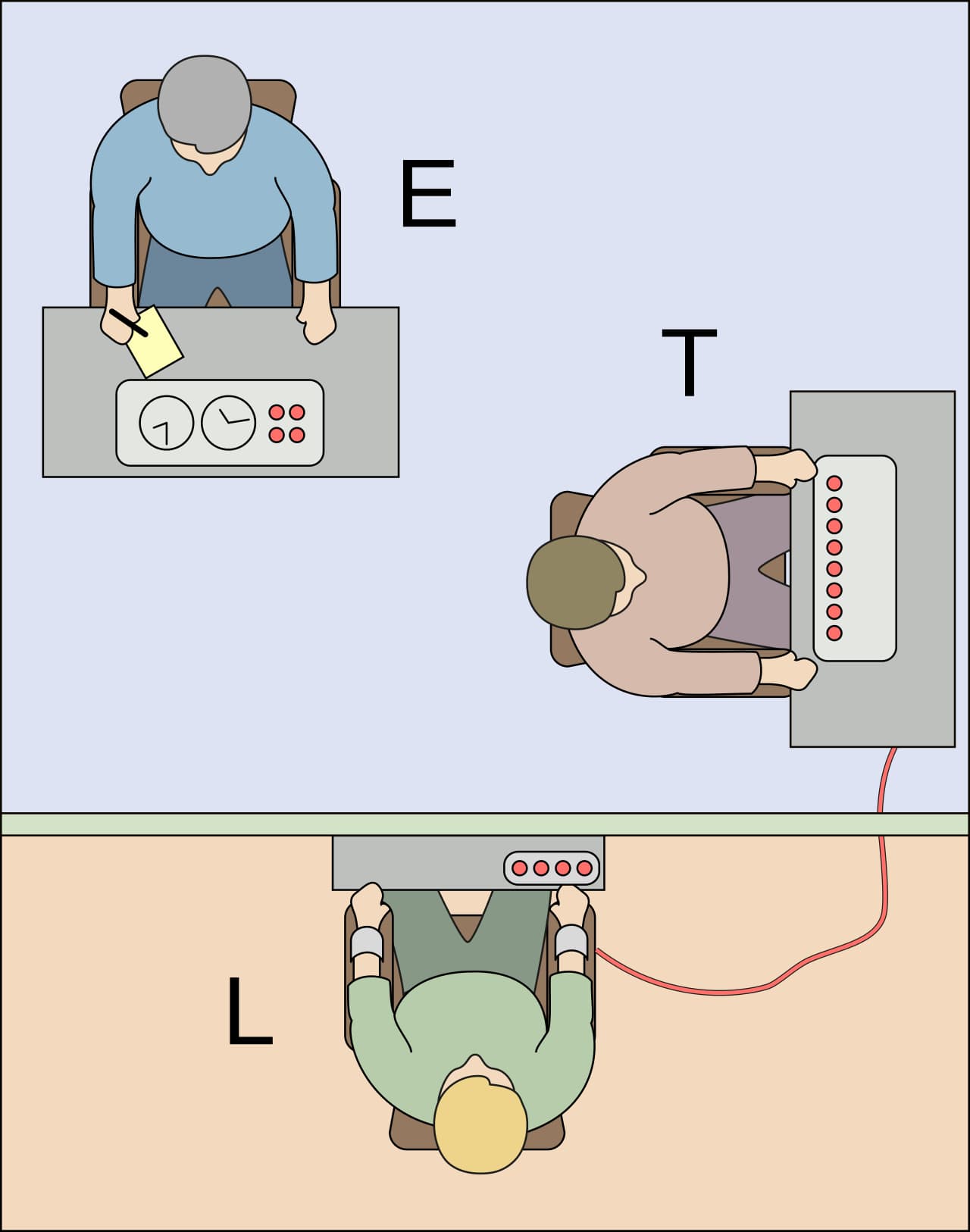
The setup was convincing. The learner was an actor, strapped into what looked like an electric chair in an adjacent room; the shocks were fake, and a tape recorder played recorded sounds for each level, while the voltage rose in 15-volt steps up to 450, marked "Danger: Severe Shock". In the standard version, every participant went up to 300 volts and 65% went all the way to 450. Beforehand, forty psychiatrists had predicted that only a little over one in a thousand would reach the top. Milgram started three months after Adolf Eichmann's trial opened in Jerusalem, to test whether Holocaust accomplices could validly claim they were just following orders.
65%
Circumstances mattered. With teacher and learner in the same room, obedience dropped to 40%; in a modest office with no apparent link to Yale it was 47.5%, though that difference was not statistically significant. Volunteers sweated, trembled and stuttered, and some had nervous laughing fits. The study remains contested. Diana Baumrind argued that consent didn't free Milgram from protecting participants' well-being, and in 2012 psychologist Gina Perry, after studying his data, concluded that only half of the participants fully believed the shocks were real, and that two-thirds of those disobeyed. Replications have found rates from 28% to 91%.
Quiz me
0/3
Recap
Obedience in Milgram's studies rose and fell with circumstances, such as how close the victim was, and later critics have questioned how much of it was real belief.
Surprising fact · 65% of volunteers delivered the maximum 450-volt shock, far more than experts predicted.
Sources (1)
No source, no claim. Every fact in this lesson (27 claims) cites at least one of these.