Why can't the square root of 2 ever be written as a fraction?
Legend says the Greek who proved it was thrown overboard. Yet the number he uncovered is hiding in every sheet of A4 paper.
▶ Start the storyThe square root of 2 can't be a fraction because assuming it is leads to a contradiction: a number that would have to be both odd and even. Numbers like that, which can't be written as one whole number divided by another, are called irrational. Their decimals never end and never fall into a repeating pattern. The square root of 2, about 1.4142, is the length of the diagonal of a square whose sides are 1, and it was probably the first number ever known to be irrational.
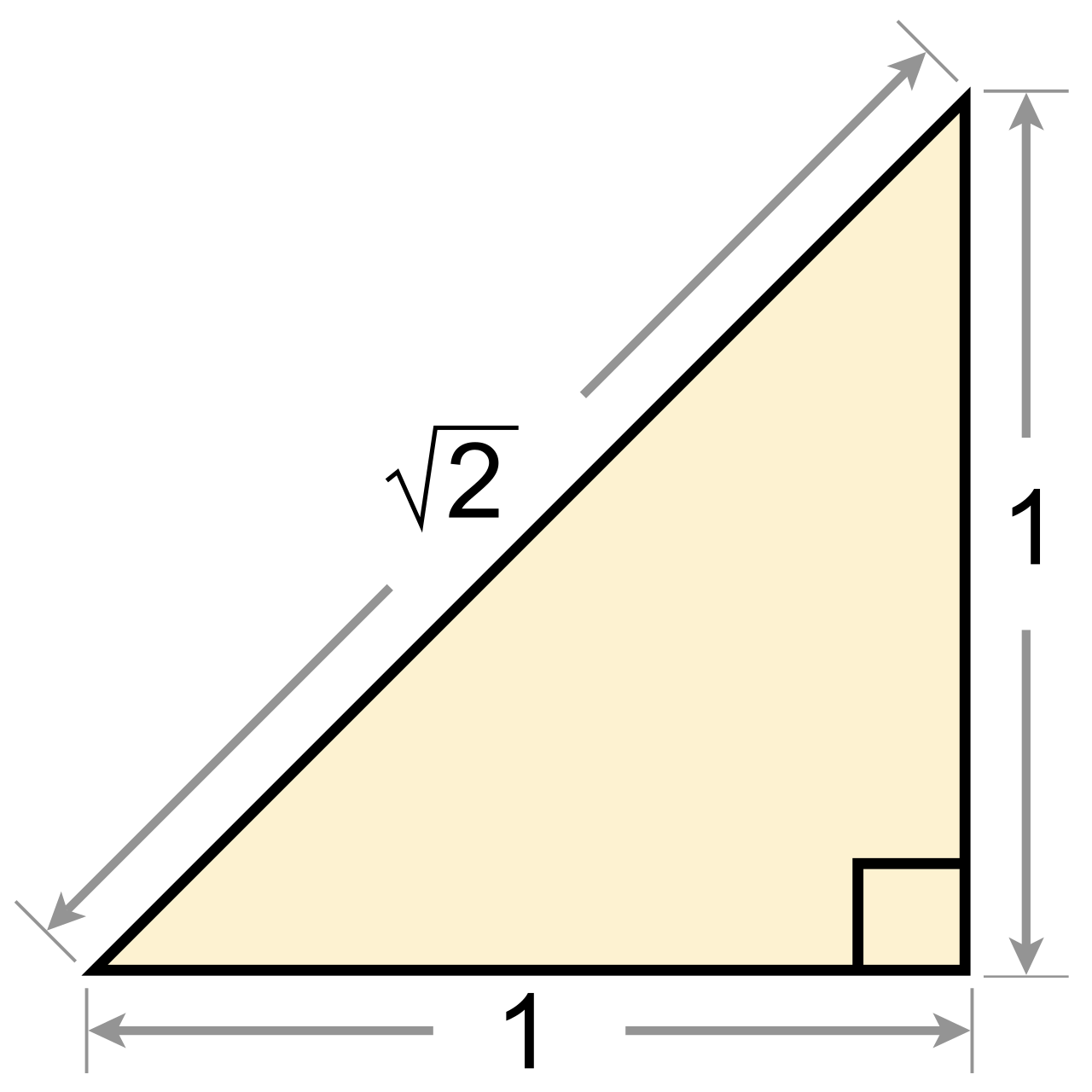
The proof is a little gem. Suppose the diagonal and the side of that square could both be measured as whole numbers with no common factor. The Pythagorean theorem then forces both numbers to be even, so they share the factor 2 after all. That contradiction means no such fraction exists. Put another way, no unit of length, however tiny, measures both the side and the diagonal a whole number of times.
The discovery is credited to a follower of Pythagoras, possibly Hippasus, in the 5th century BC. It shook a school that believed numbers and geometry went hand in hand, and legend says Hippasus was thrown overboard for it, or perhaps just exiled. The Greeks called such ratios alogos: inexpressible.
You hold the number all the time. A4 paper uses it: a sheet whose sides are in that ratio can be cut in half into two sheets of exactly the same shape.
Quiz me
0/3
Recap
Assume the square root of 2 is a fraction in lowest terms, and both parts turn out even: a contradiction.
Surprising fact · A4 paper is built on the square root of 2, so that halving a sheet keeps the same shape.
Connects to
Sources (2)
No source, no claim. Every fact in this lesson (19 claims) cites at least one of these.