How can infinitely many numbers add up to something finite?
Half, plus a quarter, plus an eighth, forever: you never stop adding, yet you never pass 1. The same trick proves 0.999... is exactly 1.
▶ Start the storyInfinitely many numbers can add up to something finite when each one is a fixed fraction of the one before, and that fraction is smaller than 1. Such a sum is called a geometric series: you start with a number and keep multiplying by the same ratio. If the ratio is smaller than 1, the terms shrink towards zero and the running total settles on a limit. If it is bigger than 1, the total grows without end.
The classic example comes from a walk. Before you reach a door, you must cover half the distance, then half of what's left, then half of that, forever. Zeno of Elea used this 2,500 years ago to puzzle the Greeks, who believed an endless list of positive numbers had to add up to infinity. But all those halves together are just the one fixed distance to the door. Adding the first terms shows it, in a quick calculation: half, then three quarters, then seven eighths, creeping towards the whole without ever passing it.
Adding halves: the total creeps towards 1
| Running total of 1/2 + 1/4 + 1/8 + ... | |
|---|---|
| 1 term | 0.5 |
| 2 terms | 0.75 |
| 3 terms | 0.875 |
| 4 terms | 0.938 |
| 5 terms | 0.969 |
| 6 terms | 0.984 |
The same idea settles a famous argument. Any repeating decimal is a geometric series in disguise, and that is how you can prove that 0.999... is not almost 1 but exactly 1. The proof appears in Leonhard Euler's algebra book of 1770, yet when the educator David Tall interviewed his college students, most of them initially refused to believe it.
Turn the ratio above 1 and you get the opposite: doubling grains of wheat on 64 chessboard squares gives more than 18 quintillion grains.
Quiz me
0/3
Recap
Shrinking ratio, finite sum; growing ratio, endless growth.
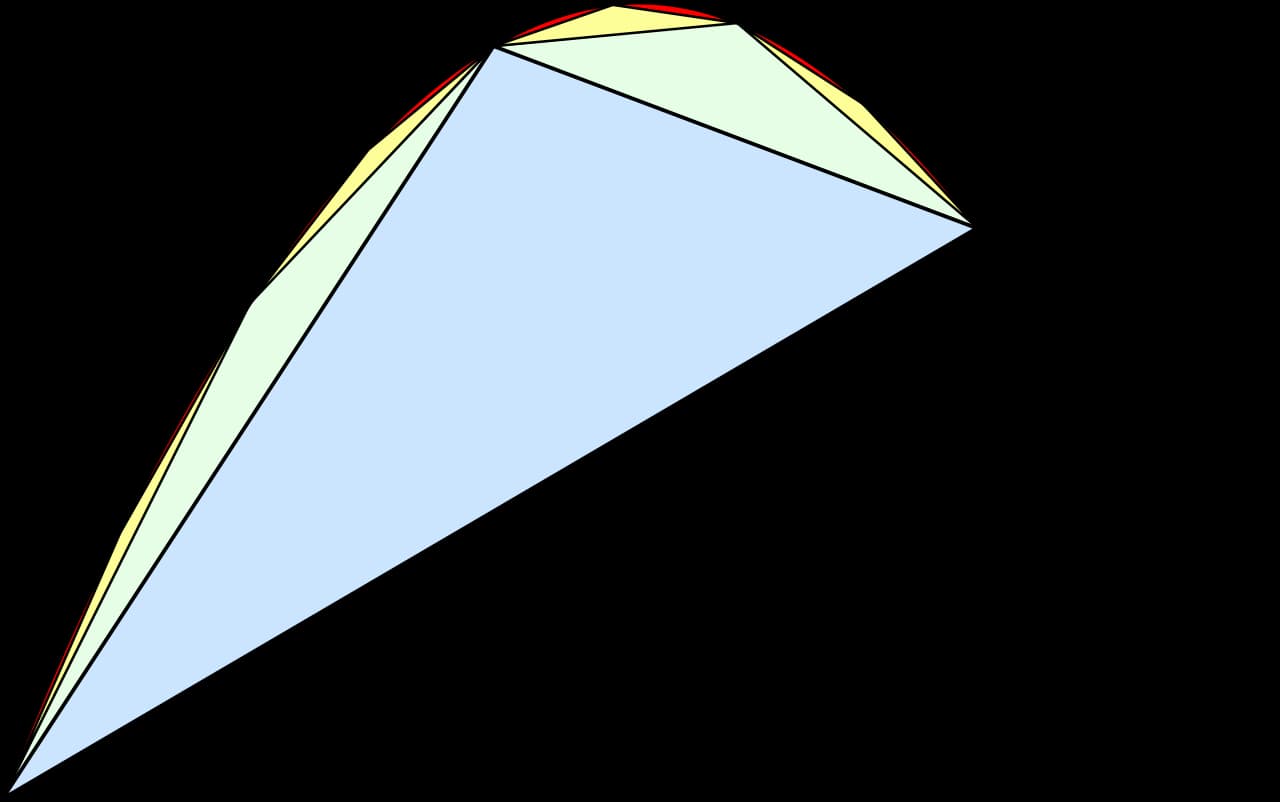
Surprising fact · Archimedes summed an infinite geometric series to find the area under a parabola, nearly two thousand years before integral calculus.
Connects to
- √ Why can't the square root of 2 ever be written as a fraction?
- ❄️ How can a shape have 1.26 dimensions?
- 🐢 How can the fastest runner ever catch a tortoise, if he must first reach where it was?
- 🌾 How could one grain of wheat, doubled across a chessboard, outgrow the world?
- 💵 Why does money lose value over time?
Sources (4)
No source, no claim. Every fact in this lesson (20 claims) cites at least one of these.