Can a black hole evaporate?
Nothing escapes a black hole, yet Stephen Hawking showed in 1974 that black holes should glow, shrink and one day vanish.
▶ Start the storyIn theory, yes, but almost unimaginably slowly. In 1974 Stephen Hawking showed that quantum effects make a black hole give off a faint glow from just outside its event horizon, now called Hawking radiation. That radiation carries away energy, so a black hole that swallows nothing new should slowly lose mass, shrink and eventually vanish.
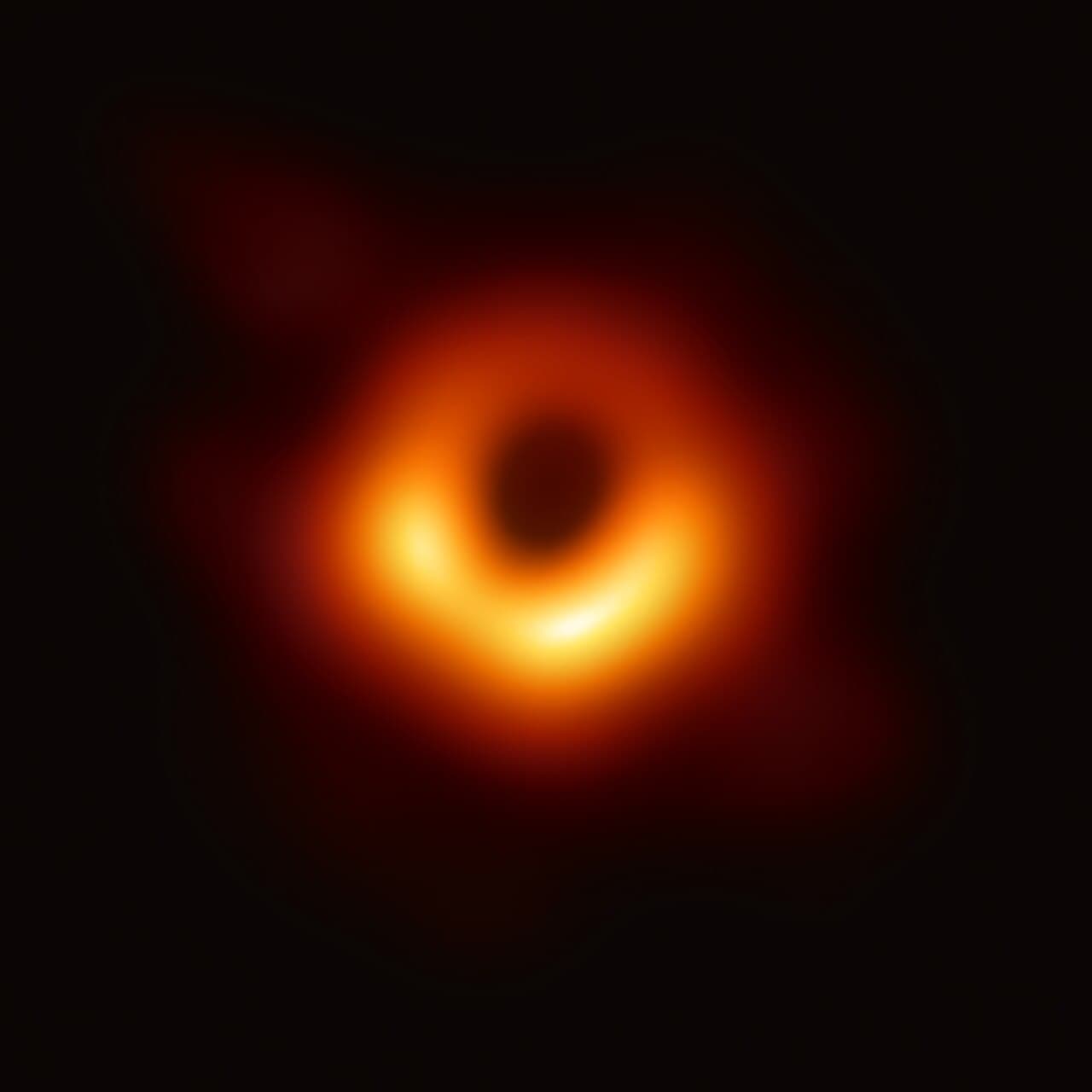
The catch is temperature. A black hole's Hawking temperature goes down as its mass goes up, so big black holes are incredibly cold. Even the smallest black holes made by dying stars, about three times the Sun's mass, sit at roughly a ten-millionth of a degree above absolute zero. The empty universe around them is warmer, bathed in the 2.7-degree glow of the cosmic microwave background. So no stellar black hole can be evaporating today. A black hole of the Sun's mass would need more than 10^67 years, a 1 followed by 67 zeros, which dwarfs the 14 billion years the universe has existed.
Only tiny black holes, with less than 0.8% of Earth's mass, would be hot enough to evaporate now. No star can collapse into something that small, but such primordial black holes might have formed in the early universe. As they shrank they would heat up and lose mass ever faster, ending in a burst of high-energy radiation. NASA's Fermi space telescope has been watching for those final flashes since 2008, and none has been seen.
Hawking didn't reach this idea easily. In 1972 a young physicist, Jacob Bekenstein, argued that black holes have entropy, and Hawking at first fought him. When Hawking did the calculation, it proved Bekenstein right: anything with entropy has a temperature, and anything with a temperature glows.
Quiz me
0/3
Recap
The lighter the black hole, the hotter it glows and the faster it evaporates; star-sized ones are colder than space and won't evaporate for over 10^67 years.
Surprising fact · Hawking paid off a bet about black holes with a baseball encyclopedia, a book 'from which information can be retrieved at will'.
Connects to
- ♨️ Why can't some physical processes ever run backward?
- 📡 What is the faint glow left over from the Big Bang?
- 〰️ How did we feel two black holes collide a billion light-years away?
- 🧱 How can a particle pass through a wall it doesn't have the energy to climb?
- 🕳️ What happens at a black hole's point of no return?
- General relativity
- Gravitational time dilation
Sources (5)
No source, no claim. Every fact in this lesson (29 claims) cites at least one of these.