Why is a black hole actually invisible?
It took 235 years from the first calculation to the first picture, and the picture shows a shadow, not the hole itself.
▶ Start the storyA black hole looks black because nothing it touches can ever send light back out to tell you about it. It is an astronomical body so compact that its gravity prevents anything, including light, from escaping, and the boundary where escape becomes impossible is called the event horizon. Crossing it produces no locally detectable change, yet whatever crosses is trapped inside.
The idea is older than you'd guess. In 1784, the English astronomer and clergyman John Michell worked out that a star as dense as the Sun but 500 times wider would have a surface escape velocity faster than light itself, so even light couldn't get away. He even guessed correctly that such invisible stars could still be detected by their pull on visible ones nearby , which is how astronomers locate them today.
Einstein's general relativity, published in 1915, gave the idea a real foundation by explaining how matter shapes spacetime. Months later, Karl Schwarzschild solved Einstein's equations for a spherical mass and found a radius where some terms became infinite; nobody at the time understood what it meant. Many physicists doubted such objects could exist, and in 1939 Einstein himself tried to prove them impossible. Only in the 1960s did theory show that black holes are a generic prediction of general relativity.
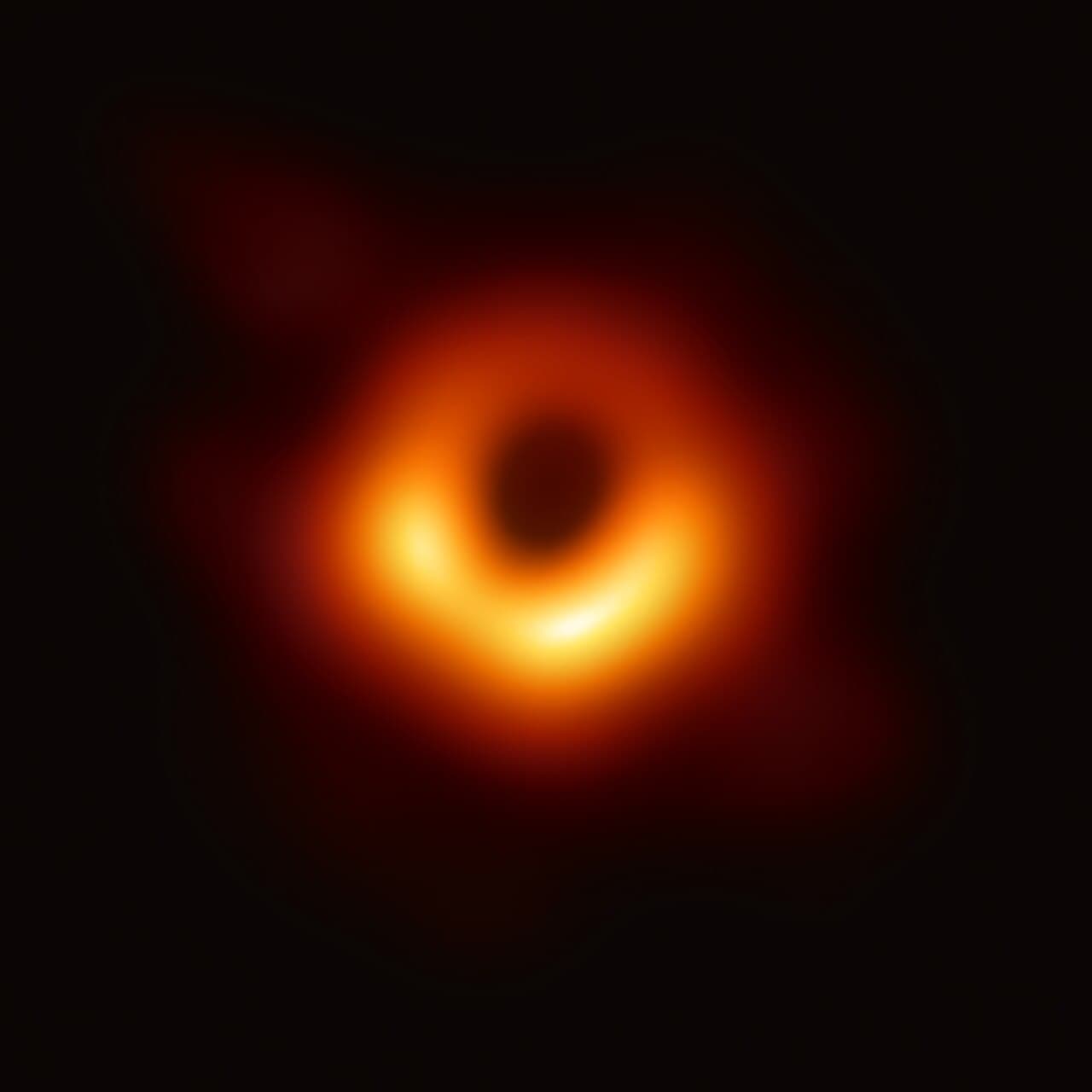
Today black holes are found through what happens around them: infalling matter heats up in a glowing accretion disk, stars orbiting an invisible point reveal its mass, and merging black holes give off gravitational waves. In 2019, the Event Horizon Telescope published the first direct image of a black hole and its surroundings, in the galaxy Messier 87: a ring of glowing matter around a dark shadow, since the hole itself emits nothing.
Quiz me
0/3
Recap
You never see a black hole itself, only the glowing matter and shadow it casts.
Surprising fact · John Michell described the core idea of a black hole in 1784, with a calculation of escape velocity.
Sources (1)
No source, no claim. Every fact in this lesson (21 claims) cites at least one of these.