Do birds have regional accents?
Young songbirds babble before they can sing, practise for months, and pick up their father's quirks along the way. Whether that adds up to an 'accent' is still debated.
▶ Start the storyIn a sense, yes, though scientists argue over the word. In many species the basic song is the same for every bird, but young birds learn some details from their fathers, and these variations build up over generations into what are called dialects. Chaffinch song types, for instance, cluster in particular areas. Some researchers caution that these aren't dialects like ours: not every bird in an area sings the local type, and no single feature sets one type apart from all the others, the way certain words belong only to one human dialect.
The learning itself looks a lot like a baby learning to talk. A chick first listens to an adult's song and memorizes it as a template. Then it practises its own voice against that memory. The first attempts, called 'sub-song', are so variable that researchers compare them to a human infant's babbling. Soon the song becomes a recognisable but loose 'plastic song', and after two or three months it settles into a stable 'crystallized song'.
People have known that birds learn their calls since at least 1773, and cross-fostering experiments even got a linnet to learn a skylark's song. In 1954 the researcher Thorpe showed how much tutoring matters: chaffinches raised alone from their first week sang abnormal, simpler songs. Song learning is a form of motor learning involving the basal ganglia, and models of it help researchers model how humans learn speech.
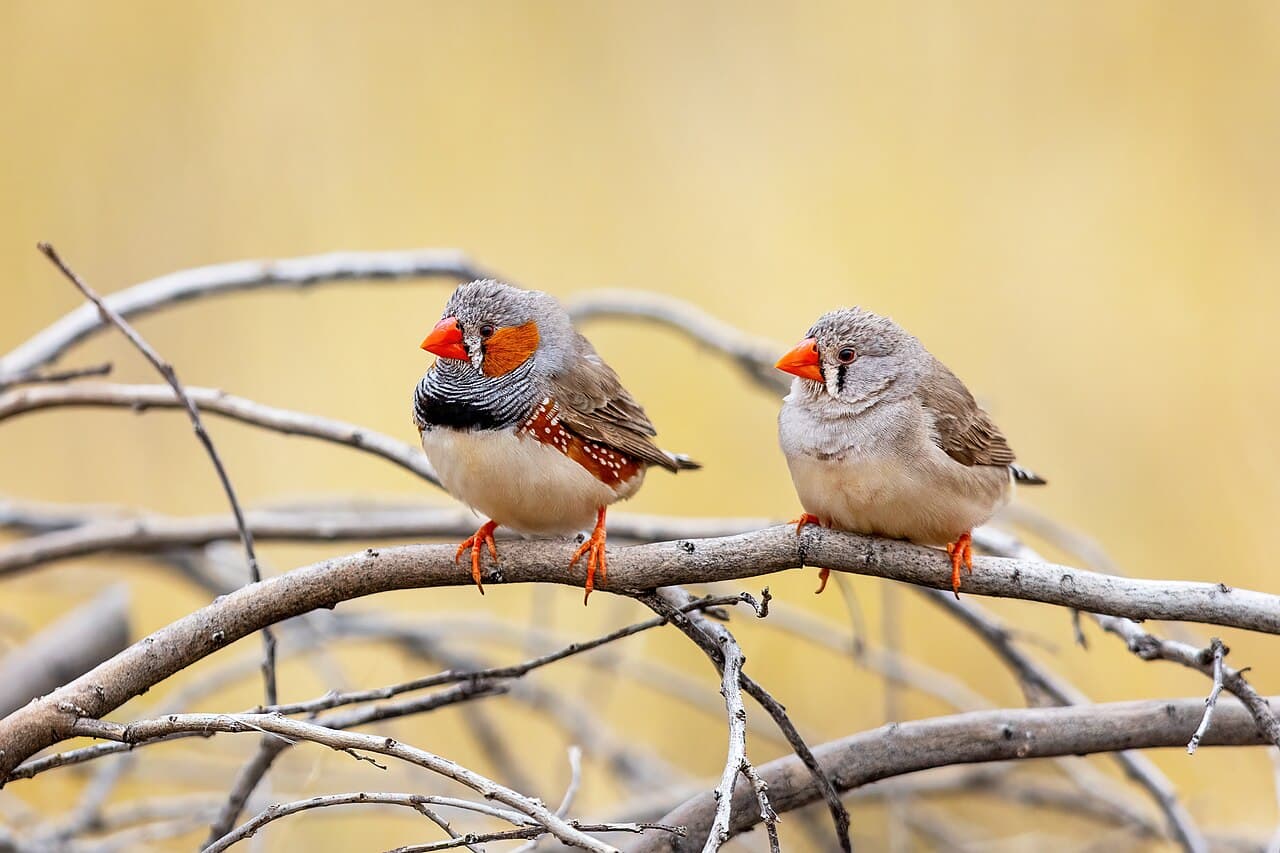
Not every bird keeps learning. Zebra finches lock in their song within their first year, while canaries can pick up new songs as adults.
Quiz me
0/3
Recap
If a young bird's early singing sounds like noisy babbling, that's not a flaw: it is literally called 'sub-song,' the same learning stage as a human baby's babble.
Surprising fact · A cross-fostering experiment showed a linnet raised among skylarks learned the skylark's song instead of its own species' song, showing birdsong is culturally learned.
Sources (1)
No source, no claim. Every fact in this lesson (17 claims) cites at least one of these.