How can a shape have 1.26 dimensions?
The Koch snowflake is too crinkly to be a line and too thin to be a surface, so mathematicians gave it a dimension in between.
▶ Start the storyBecause dimension can be defined by how a shape responds to zooming, and some shapes respond in between. Shrink a ruler to a third of a line's length and 3 copies fit along it. Shrink a tile to a third of a square's side and 9 copies, 3 squared, fit inside it. The power, 1 for the line and 2 for the square, is the dimension. Fractal dimension keeps exactly that rule but lets the power be a fraction.
Now take the Koch curve. At each step every segment is replaced by 4 segments, each a third as long. Zoom in by 3 and you find 4 copies of the whole. So 3 to the power D must equal 4, and D is about 1.26. The curve is too detailed to be a line, yet too thin to fill a surface. Its snowflake version even encloses a finite area inside an infinite perimeter.
Step 1: Zoom by a factor
Shrink the shape's pieces by a scale factor, say 3.
Step 2: Count the copies
Line: 3. Square: 9. Koch curve: 4.
Step 3: Solve for the power
Copies = scale ^ D, so D = log(copies) / log(scale).
Step 4: Read the answer
Koch: log 4 / log 3 ≈ 1.26, between a line and a surface.
The same recipe works for other famous shapes. The Sierpinski triangle is 3 copies of itself at half size, giving about 1.58. The Cantor set, a line with its middle thirds removed again and again, is 2 copies at a third of the size: about 0.63, less than a line but more than a scatter of points.
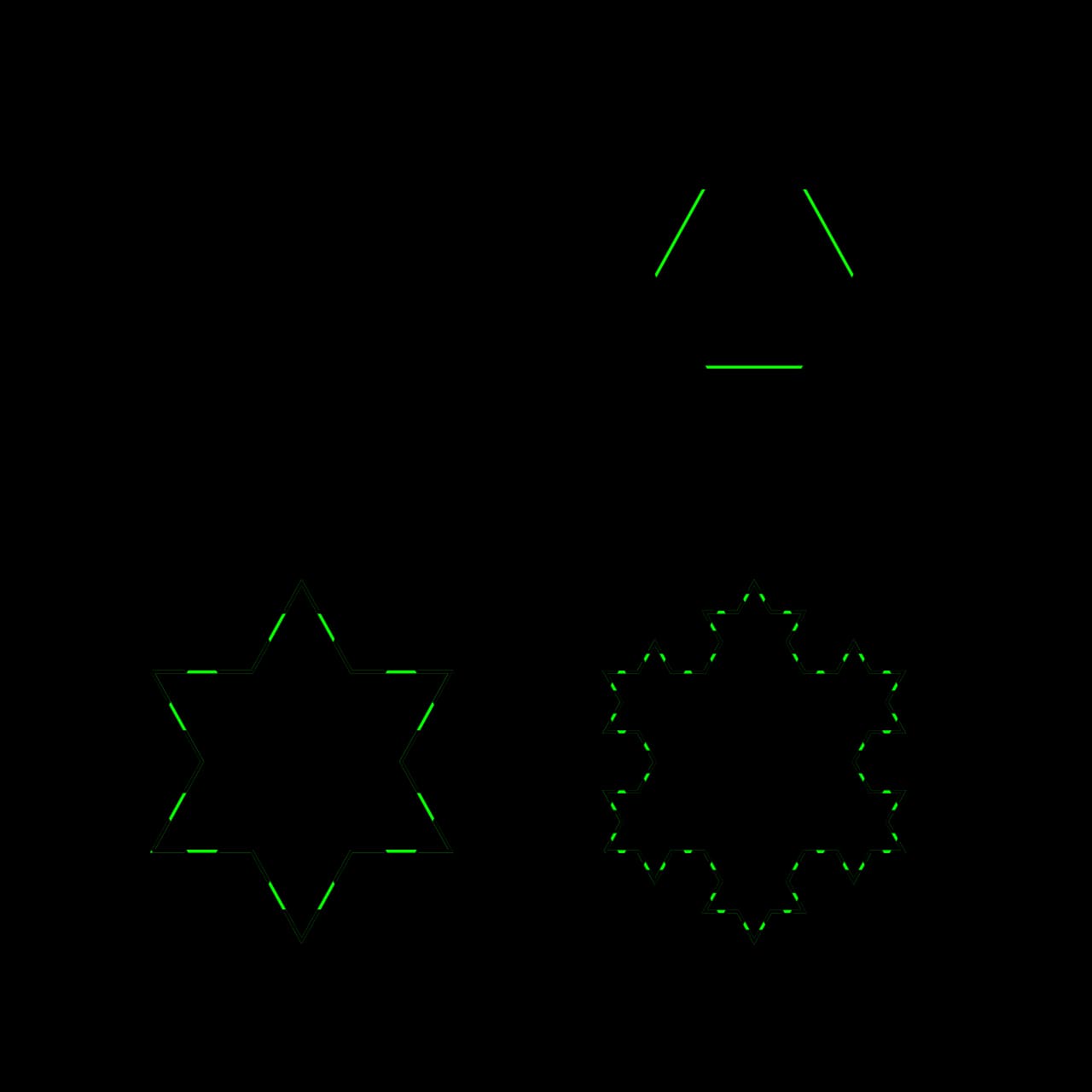
When von Koch described his curve in 1904, shapes like it were seen as mathematical "monsters". In 1975 Benoit Mandelbrot gave them a name, fractals, and showed that the fractional dimension measures something real: not size, but roughness, how much new detail appears every time you look closer.
Quiz me
0/3
Recap
Copies = scale ^ dimension: 4 copies at a third of the size gives the Koch curve log 4 / log 3 ≈ 1.26.
Surprising fact · Curves like von Koch's were once called mathematical "monsters".
Sources (5)
No source, no claim. Every fact in this lesson (23 claims) cites at least one of these.