How can a snowflake shape have an infinite edge but a finite area?
You could paint the inside of the Koch snowflake with a single can, but no length of ribbon would ever go around it.
▶ Start the storyBecause every time you add detail, the edge gets longer by a third, while the area only grows by smaller and smaller crumbs. Start with an equilateral triangle. Split each side into three equal parts, build a small outward-pointing triangle on the middle part, and remove its base. You now have a six-pointed star. Do it again on every new side, and again, forever. The limit is the Koch snowflake.
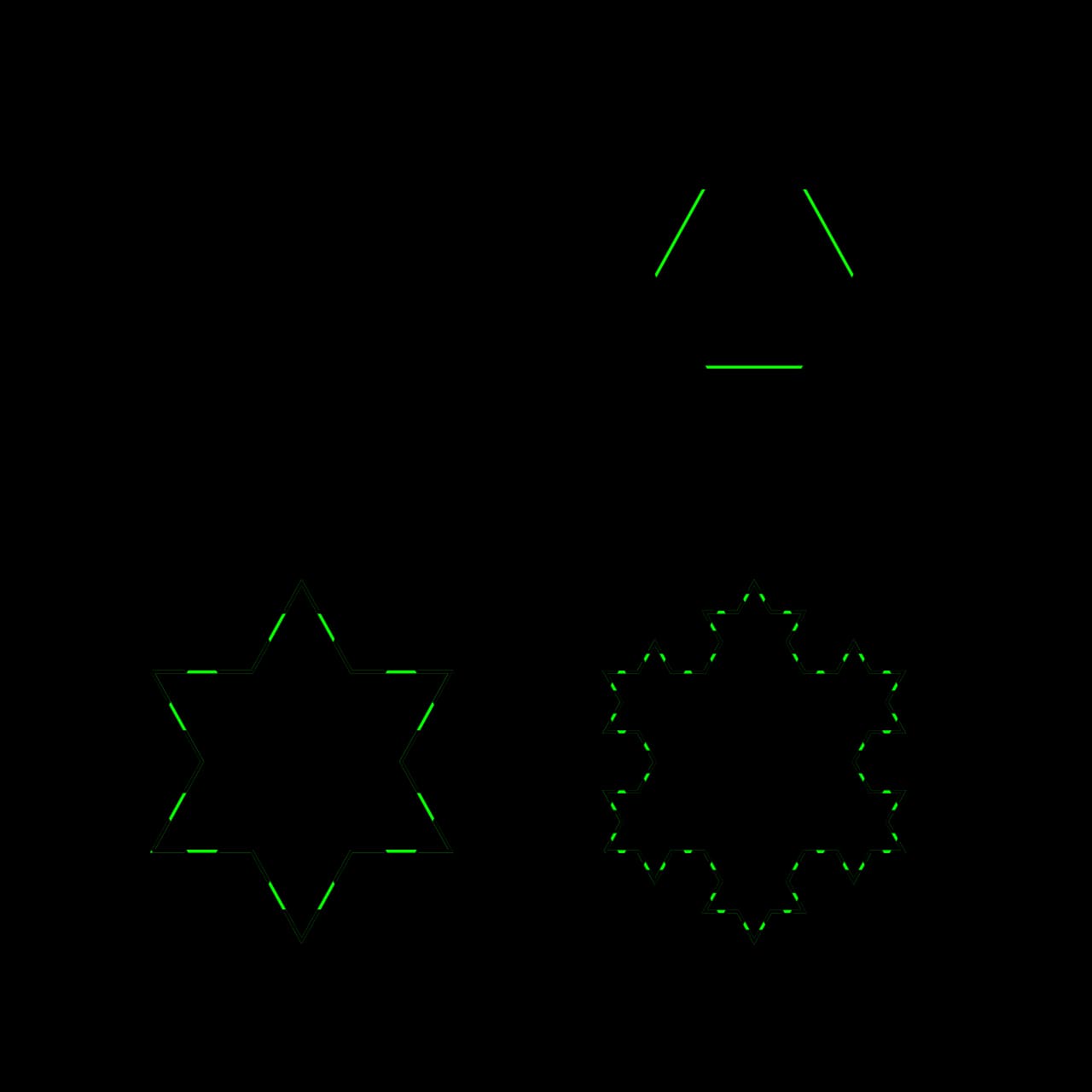
Each round replaces every straight piece with four pieces one third as long, so the total edge is multiplied by 4/3. Multiply by 4/3 forever and the perimeter grows without limit. But the new triangles get tiny fast: each is one ninth the area of the one before. The added area forms a shrinking sum that settles at exactly 8/5 of the starting triangle. Finite paint, infinite fence.
The Swedish mathematician Helge von Koch described the curve in 1904. He wanted something strange that you could actually see: a continuous curve with no tangent line anywhere, a line made entirely of corners. Earlier examples were pure formulas; Koch's could be drawn, so even "naive intuition" could grasp it. Funnily enough, the full snowflake isn't in his paper: he drew one side, and the closed snowflake may be due to the American mathematician Edward Kasner.
Quiz me
0/3
Recap
Each step multiplies the edge by 4/3 but adds only shrinking crumbs of area: infinite fence, finite field.
Surprising fact · Its area is exactly 8/5 of the starting triangle, yet its perimeter is infinite.
Sources (4)
No source, no claim. Every fact in this lesson (17 claims) cites at least one of these.