How did a Danish telephone engineer invent the mathematics of waiting in line?
To work out how many phone lines Copenhagen needed, Agner Erlang climbed into manholes. His maths now runs supermarkets, hospitals and the internet.
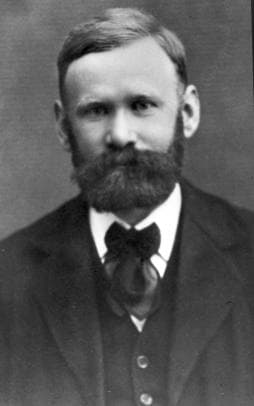
▶ Start the storyAgner Krarup Erlang invented the mathematics of waiting in line because his employer, the Copenhagen Telephone Exchange, needed to know how many lines and operators it needed. Calls arrive at random, and if too few lines are free, callers wait or get cut off. In 1909 Erlang published the first paper on what we now call queueing theory: the mathematical study of queues, which predicts how long lines get and how long people wait.

Erlang was no armchair theorist. He took his own measurements and was willing to climb down into street manholes to get them. His formulas, which link the quality of a service to the number of servers available, are still used, and since 1946 the international unit of telephone traffic has been called the erlang.
The same maths fits any queue: a supermarket checkout, a hospital ward, a web server. One of its neatest results is Little's law: the average number of people in a system equals how fast they arrive times how long each stays. It holds whatever the arrival pattern or the order of service. A quick calculation with it: if a café has on average 10 customers inside and 2 arrive each minute, each spends about 5 minutes there.
Queueing theory also helped build the internet. In the early 1970s, Leonard Kleinrock's queueing work underpinned packet switching on the ARPANET, the internet's forerunner, where data waits its turn in queues inside routers.
Quiz me
0/3
Recap
Little's law: average number in the system equals arrival rate times average time spent inside.
Surprising fact · The international unit of telephone traffic, the erlang, is named after the Danish engineer who founded the field in 1909.
Connects to
- 🎲 How did an unfinished game of chance give birth to probability theory?
- 🕸️ What do your friendships, molecules and road maps have in common?
- ⚖️ Who actually decides what things cost?
- 📦 How does the internet deliver your data without ever giving you a line of your own?
- 💬 What was the first message ever sent over the internet's ancestor?
Sources (4)
No source, no claim. Every fact in this lesson (20 claims) cites at least one of these.