How did a runaway printer's apprentice become a Founding Father?
At 17, Benjamin Franklin, a printer's apprentice, ran away to Philadelphia to start over. He went on to chart an ocean current, invent the lightning rod, and become the only person to sign all three of America's founding documents.
▶ Start the storyBenjamin Franklin started out as a runaway. Apprenticed at 12 to his brother James, a Boston printer, he ran away to Philadelphia at 17, seeking a new start in a new city. He built himself up the way he knew: printing. But the habit he brought with him, forming a club to argue about ideas over borrowed books, is what really built his career. In 1727 he founded the Junto, a discussion circle modeled on English coffeehouses, whose members first pooled their own books, then their money, in a subscription library: the Library Company of Philadelphia.
Franklin's curiosity didn't stop at print and politics. Studying static electricity, he was the first to argue that so-called "vitreous" and "resinous" electricity were really the same fluid at different pressures, coined the terms positive and negative charge still used today, and discovered the principle of conservation of charge. That theoretical work led directly to a practical one: the lightning rod, a sharpened iron rod wired into the ground that could draw a storm's electrical charge away from a building before it struck. True to character, he never patented it, or anything else he invented, writing that people should serve each other freely with their inventions since they themselves benefit from the inventions of others.
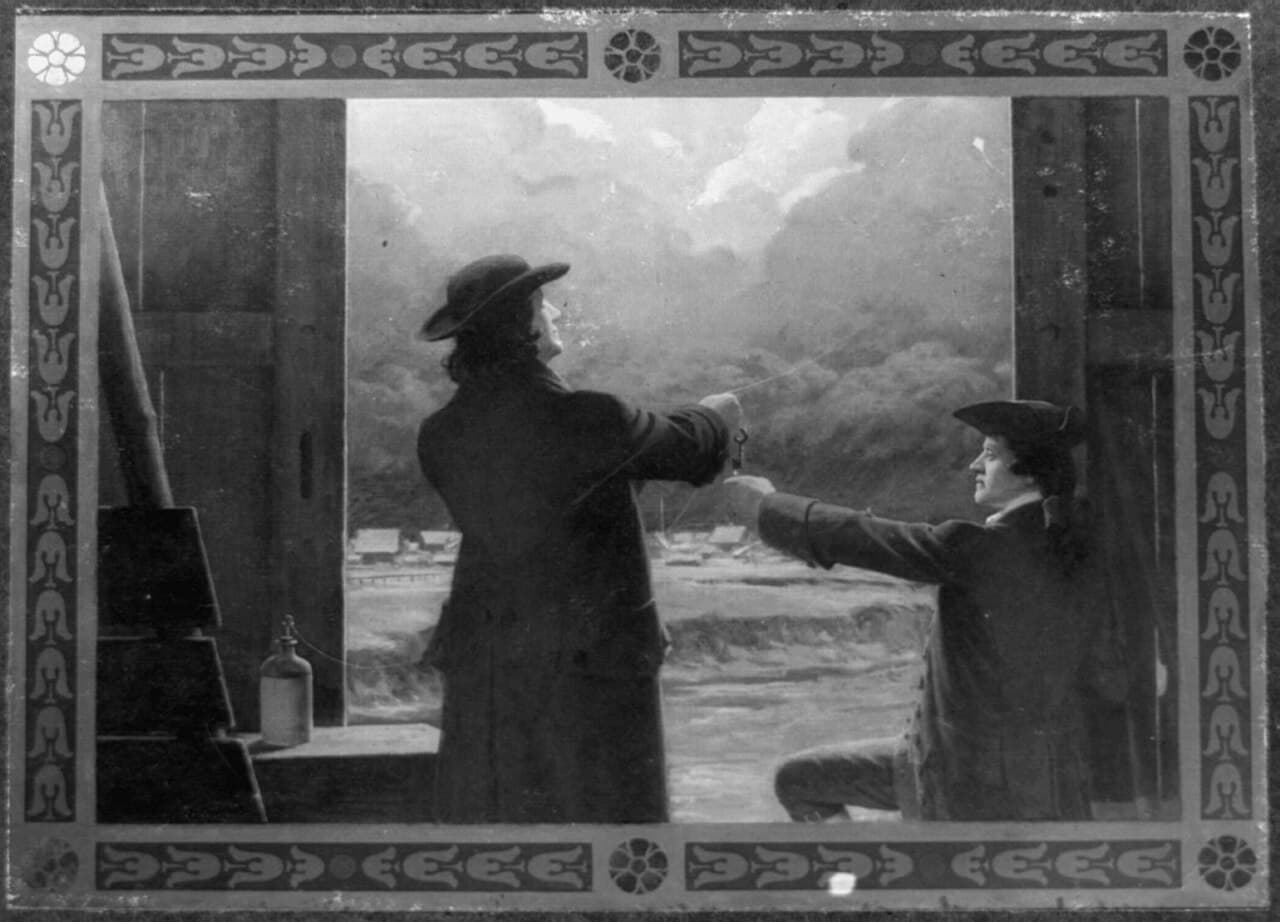
He even solved a shipping mystery: why British mail ships took weeks longer to cross the Atlantic than merchant ships. With his cousin, a whaling captain, he charted and named the Gulf Stream, and once British captains finally followed his advice, they cut two weeks off their sailing time. And he was flawed: for decades he owned slaves and advertised their sale in his own newspaper, before reversing course in his later years to become an active abolitionist. He remains the only person who signed the Declaration of Independence, the Treaty of Paris, and the Constitution.
Quiz me
0/3
Recap
A runaway apprentice's coffeehouse-style discussion club led to the Library Company of Philadelphia, while his electrical experiments gave the world the lightning rod, the terms positive and negative charge, and a current still called the Gulf Stream.
Surprising fact · He refused to patent any of his inventions, including the lightning rod, believing ideas should be shared freely.
Sources (1)
No source, no claim. Every fact in this lesson (16 claims) cites at least one of these.