What actually stops a skyscraper from swaying into the street?
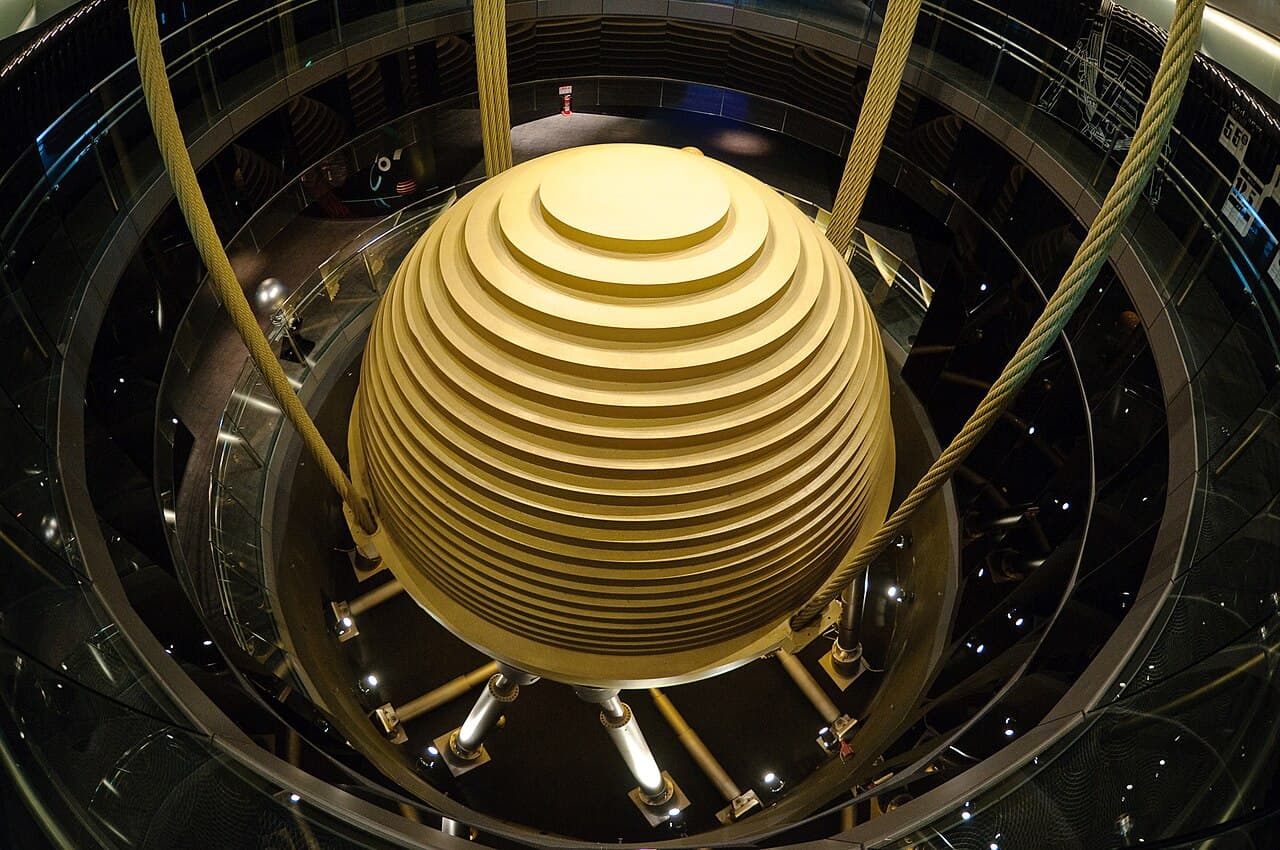
A 660-metric-ton ball hangs inside Taipei 101, built to swing against the tower's own motion so the whole building sways less in the wind.
▶ Start the storyMostly two things: a stiff structural frame that resists the wind as a whole, and, in some towers, a huge tuned mass damper that swings against the sway. But skyscrapers first had to solve two older problems: how to get people up, and how to keep the building itself from falling down. The elevator solved the first problem; since most people would never climb dozens of flights of stairs, the invention of a safe elevator was a precondition for skyscrapers existing at all. Elisha Otis introduced his safety elevator in 1857, and architect William Le Baron Jenney solved the second, designing a steel frame strong enough to carry a building's entire weight itself, launching what became known as "Chicago skeleton" construction.
But holding a building up isn't the hardest part once it gets tall enough; keeping it still is. Past a certain height, wind, not weight, becomes the main force engineers have to design against. Engineer Fazlur Rahman Khan addressed this in 1963 with the framed tube, a design where closely spaced columns around a building's exterior act together like a single hollow cylinder, resisting wind as a unit rather than leaving it to a few interior columns. His later X-braced "trussed tube," first used on Chicago's John Hancock Center, pushed the idea further, transferring lateral loads directly into the exterior skin.
Even with a strong frame, very tall buildings still sway, and modern engineering counters that sway with a trick that sounds almost too simple: add a second, deliberately loose mass that moves against the building's motion. The John Hancock Tower in Boston, built in 1976, was the first building to use one of these tuned mass dampers, added after the tower was finished. Taipei 101 took the idea to an extreme: between its 87th and 92nd floors hangs a damper weighing 660 metric tons, for years the heaviest damper of its kind in the world, swinging gently on purpose every time the wind pushes the tower, so the building doesn't have to.
Quiz me
0/3
Recap
Elisha Otis's 1857 safety elevator and William Le Baron Jenney's steel frame made skyscrapers possible; Fazlur Khan's framed tube and tuned mass dampers like Taipei 101's keep them from swaying too far in the wind.
Surprising fact · Taipei 101's 660-metric-ton tuned mass damper swings on purpose to reduce the tower's wind-driven sway.
Sources (2)
No source, no claim. Every fact in this lesson (11 claims) cites at least one of these.