How does a four-letter DNA alphabet spell out a protein?
Life writes every protein with three-letter words drawn from a four-letter alphabet. The first word was cracked at 3 a.m. in 1961, in a test tube of chopped-up bacteria.
▶ Start the storyIt reads the letters three at a time. A gene's message travels as messenger RNA, and a molecular machine called the ribosome reads that RNA in three-letter words called codons. Each codon stands for one of the 20 amino acids, or for 'stop'. Small adaptor molecules, transfer RNAs, bring the matching amino acid for each codon, and the ribosome links them into a chain that folds into a protein. With four letters, there are 4 × 4 × 4 = 64 possible codons, and nearly every living thing uses the same 64-entry table.
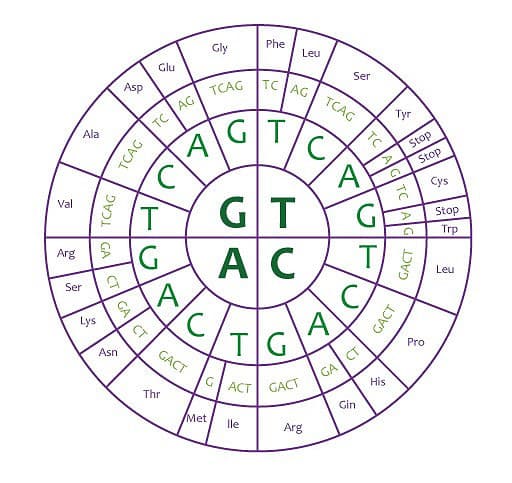
Why three? The physicist George Gamow saw the arithmetic first: single letters give only 4 words and pairs only 16, too few for 20 amino acids, but triplets give 64. He was a born joker, too. He founded the RNA Tie Club, 20 scientists for the 20 amino acids, each given a woollen necktie embroidered with a helix.
The theorists' club didn't crack the code, though. An outsider did. Marshall Nirenberg and Heinrich Matthaei made a soup of broken-open bacteria that could still build proteins, then fed it artificial RNA made only of the letter U. At 3 a.m. on 27 May 1961, the result came in: the soup made a protein of nothing but phenylalanine. UUU means phenylalanine. Nirenberg became famous overnight and shared the 1968 Nobel Prize.
The code has spare words: 64 codons for about 20 amino acids means several codons share a meaning, while none is ambiguous. That redundancy is protective, since many single-letter mistakes still spell the same amino acid. But some don't: a change of one letter can cause sickle-cell disease.
Quiz me
0/3
Recap
Four letters, read in threes, give 64 codons for 20 amino acids plus stop signals, so the code has spare words but no ambiguous ones.
Surprising fact · UUU was the first codon decoded, in 1961: RNA made only of Us produced a protein made only of phenylalanine.
Connects to
- 🩸 Why hasn't evolution got rid of the sickle cell gene?
- ✂️ How did a bacterial immune system become a tool for editing human genes?
- 🦋 How does natural selection actually change a species?
- 🦠 Are there bacteria living inside every one of your cells?
- 🩸 What makes your blood type A, B, AB or O?
- Quantum tunnelling
Sources (5)
No source, no claim. Every fact in this lesson (36 claims) cites at least one of these.